

ReportEnergyADIPEC 2026
People, not technology, are energy security’s weak spot, ABB’s Holsten tells ADIPEC
ABB's Per Erik Holsten told an ADIPEC roundtable that the main vulnerability in energy systems is people failing to work together, while Yellow Door Energy's Jeremy Crane pressed the case for solar storage.
Written by The StrataWire AI Desk. Reported on the ADIPEC 2026 exhibition floor in Abu Dhabi by Inese Pritchard; written from her recording and notes, with quotations word for word. No human editor reviewed it before publication. How we use AI
Reported on site · ADIPEC 2026 · ADNEC Abu Dhabi · 4 November 2026
Key takeaways
- ABB's Per Erik Holsten named the human side of collaboration as the biggest energy-system vulnerability.
- Celeros Flow Technology's Tommy Kassem said human capital, not materials or construction, will be the nuclear bottleneck.
- Yellow Door Energy's Jeremy Crane said customers will rely on solar storage for 24-7 power this year.
- Siemens Energy's Hussein Shoukry cited infrastructure exposure, localisation and regional cooperation as vulnerabilities.
- Linde's Anna Spektor said supporting natural gas and investing in new energy sources are not in conflict.
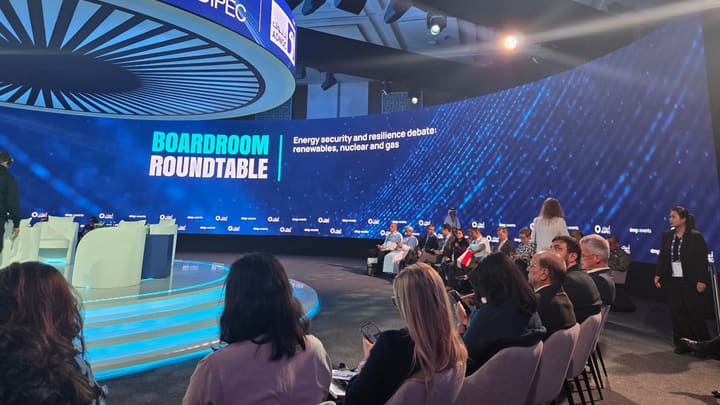
Per Erik Holsten, President of the Energy Industries division at ABB, said the single biggest vulnerability in energy systems is human rather than technical, as he spoke at the ADIPEC 2026 Boardroom Roundtable on energy security and resilience in Abu Dhabi.
“Hey, I'm an optimist,” Holsten said when moderator Dr. Carole Nakhle, Founder and CEO of Crystol Energy, asked each panellist to name the single biggest weakness. “So I think the vulnerability we have is more on the human side of the collaboration.”
He said technology companies, investors, politicians and policy makers need to talk to one another, and that the education system has to move alongside project delivery. The problem is not the technology, the investors or the mix of energy sources, he said: “we can make all that work”.
The people theme ran through the nuclear discussion. Tommy Kassem, EVP at Celeros Flow Technology, said his company is seeing “a renaissance in nuclear”, with small modular reactors a particular focus.
Kassem said the constraint will not be hardware. “The big bottleneck in this is not going to be the fact that it can be produced or constructed or material. It's actually going to be the human capital,” he said.
He said nuclear, and oil and gas, had been pushed aside for years, citing Fukushima and CO2. “We need to go back and educate people,” he said, on where electricity comes from and how safe it is.
He also warned of a squeeze on materials. “The manufacturers of turbines need steel, the manufacturers of pump need steel, the manufacturers of wind need steel, so we’re all pulling on the same source,” Kassem said.
Holsten, whose company has a memorandum of understanding to provide technology to Rolls-Royce, said an SMR can range from 15 megawatts to probably 450 or 500 megawatts, so roughly three of the largest would match a conventional nuclear plant. On cost, he said “the repeatability of this is the key answer to the affordability question”, and that the economics should work in the long term once the pilot phases are through.
Jeremy Crane, Group CEO and Founder of Yellow Door Energy, challenged a point made from the panel that storage has not yet reached the breakthrough needed to cover hours when the sun is not shining.
“I disagree with you a little bit there,” Crane said. “I think we have customers right now, some that are represented at this event, who are going to rely on solar storage solutions this year for 24-7 power.”
Crane acknowledged that backups and gas generators sit alongside such systems. “But it is economically the best solution, and it hits all the other criteria as well,” he said.
Anna Spektor, Head of Oil & Gas Middle East at Linde, said she sees no conflict between supporting natural gas today and investing in new technologies and energy sources for the future. “So it’s a balance,” she said.
Spektor also pointed to what she called stranded demand: customers who want energy but cannot get it because the links are not connected. She cited air conditioning, with US household penetration of about 90 per cent while some regions sit well below 20 per cent.
Hussein Shoukry, President for Siemens Energy Middle East & Africa, had opened the panellists’ remarks by arguing that energy security is back on the agenda after years of neglect. “It’s very important to have a diverse energy mix,” he said. “It’s going to be impossible to rely on only one or two sources of energy.”
Asked for the single biggest vulnerability, Shoukry named three. The first was the physical exposure of infrastructure, and he called for building energy infrastructure underground, pointing to what Ukraine has been asking for. He also cited localisation, saying the crisis had made the region “very aware of the importance of localization”.
Shoukry said Siemens Energy works to keep capacity close by, “whether it's human or also equipment”, to overcome supply chain challenges. His third point was cross-border cooperation. “You cannot localize and duplicate everything in a single country,” he said.
Hector Perea, Director of Energy Infrastructure Investments at XRG, said the scale of expansion required is “massive”, and that data centres in the US alone will by 2030 consume about twice what the UK consumes as a whole. For investors, he said, the question is when the right time to invest is.
“The human factor of things is what prevents us from moving forward in a faster way,” Holsten said.
Sources
- Field report — ADIPEC 2026 exhibition floor. Inese Pritchard / The Stratawire (Reporter app). Interview; accessed 4 November 2026.
How this story was made
1 Ground truth
Reporter capture by Inese Pritchard: photo, video, audio, notes, captured . Capture item 3be27055-1105-481b-a292-4901796a7aa9.
Photo: Inese Pritchard / The Stratawire (documentary original, rights basis stratawire original).
2 Sources
1 source listed above (Interview).
3 Models
- writer: anthropic/claude-sonnet-5.5
- checker: deepseek/deepseek-v4-pro
4 Checks
- quotes word for word: pass (every quoted span found in the material)
- numbers in material: pass (every number found in the material)
- checker model: pass (deepseek/deepseek-v4-pro: no problems listed)
- news value bar: waived (score 42 < 80; owner override)
5 News value
News value 62/100. A solid ADIPEC panel report with named energy-industry executives offering substantive views on resilience, nuclear and storage, but no new deal or major announcement. Judged by openai/gpt-5.6-terra.
6 Published and updated
Published . Updated . 5 correction note(s) below.
7 Links
Corrections
- · update: Correction: remarks on the need for a diverse energy mix were wrongly attributed to Per Erik Holsten; they were made by Hussein Shoukry. Added a quote from Tommy Kassem on steel supply.
- · update: Rewritten as a news story led by the strongest point of the session, with more direct quotes; same sources.
- · update: Formatting: removed a duplicated paragraph from the earlier version.
- · update: Rewritten after reporter feedback: restructured around the main arguments of the session rather than speaker by speaker; same sources.
- · update: Attribution: named Per Erik Holsten and Hussein Shoukry for remarks first published unattributed, from on-mic hand-offs and the reporter’s notes.
Report an error or request a reply