

ReportAI & Digital IndustryADIPEC 2026
KPMG says AI could support 46% of a petroleum engineer's tasks as it pitches Mystro at ADIPEC
Amal al Haris of KPMG told ADIPEC the workforce debate has moved from where work happens to who does it, and presented Mystro as a way to map which tasks AI can take on.
Written by The StrataWire AI Desk. Reported on the ADIPEC 2026 exhibition floor in Abu Dhabi by Inese Pritchard; written from her recording and notes, with quotations word for word. Background is drawn from the published sources listed below. No human editor reviewed it before publication. How we use AI
Reported on site · ADIPEC 2026 · ADNEC Abu Dhabi · 5 November 2026
Key takeaways
- Amal al Haris of KPMG said Mystro found 46% of a petroleum engineer's work can be supported by AI.
- KPMG framed the ADIPEC workforce question as moving from where work happens, to how well, to who does what.
- Mystro rates each task as high, medium or no AI support, and al Haris said it works at 500 roles and above.
- KPMG's US page says Mystro draws on 3 billion labour market data points across 15,000 roles.
- Open questions remain on agent reliability and on how far a general tool can reflect an organisation's own knowledge.
Amal al Haris of KPMG told an ADIPEC audience that the firm's Mystro tool, run on the tasks of a petroleum engineer, found that “46% of what a petroleum engineer does can be supported by AI”.
For energy employers, the figure turns a vague promise of AI productivity into a question about job design: which parts of a technical role stay with people, and which move to software. Al Haris did not go into the detail of how the analysis works during the session, so the number is a headline claim rather than a tested benchmark.
The pitch rested on a change in what executives are asking. “Today the question has fundamentally shifted,” al Haris said, from how to deploy AI to who does what once it is in the workflow.
From location to allocation
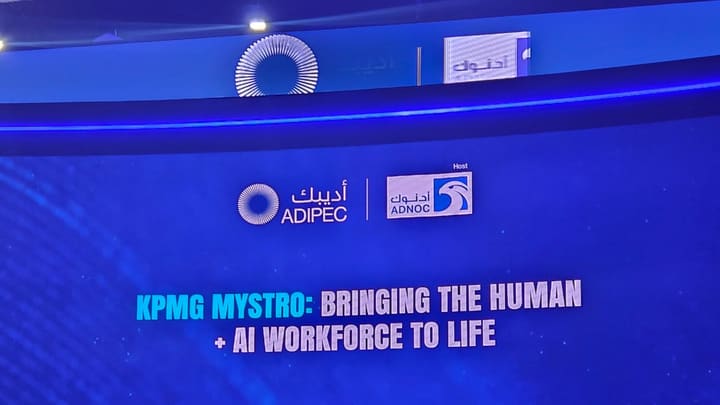
Al Haris framed the shift with three dates, which also appeared on a slide in the session titled “KPMG Mystro: Bringing the Human + AI Workforce to Life”. Three years ago the slide read “Where does work happen?”. One year ago it read “How effectively does it happen?”. Today it reads “Who does what?”.
Al Haris tied each stage to the industry's own preoccupations. “Three years ago at ADIPEC, the biggest workforce question we debated was where work happened.” In an energy context, al Haris said, that meant what happens at the rig and what can happen remotely. The topic was essentially logistics.
A year ago, the focus moved to productivity, as companies experimented with co-pilots to summarise emails and presentations. Al Haris described that as the early stage of using AI.
The current stage is different in kind, al Haris argued. “For the first time we have AI agents that are embedded in our workflows,” al Haris said, in day-to-day tasks rather than as an experiment on the side. That makes it necessary to decide what humans should continue to do.
Al Haris said clients put the same question to KPMG every day. In their words: “where do I start how do I know where across my workforce AI can support” the tasks that many people perform daily. Mystro is KPMG's answer.
What Mystro shows, and what it leaves open
In a two-minute demonstration, al Haris showed what the tool produces for a petroleum engineer. The role is broken into its component tasks, and the output marks each one according to whether AI can help a great deal, to a medium degree, or not at all. Al Haris called it a very clear visual of where AI can help.
Al Haris said the approach does not depend on the size of the organisation. With 500 roles, Mystro can still show where human input is needed and where AI can support the work, and al Haris said the same holds at larger scale.
KPMG's own product page gives some sense of the method. KPMG LLP (US) says on that page that Mystro uses 3 billion labor market data points across 15,000 roles to deconstruct human and digital labour into tasks and activities. It adds that users can see who is doing what, where it is being done and what it costs.
KPMG's UK arm, on its AI Workforce service page, describes a similar offer: helping clients identify the departments, roles, activities and skills most affected by AI and prioritise them by value and return on investment. The same page says 65% of UK workers intentionally use AI for work and 39% feel they cannot complete their work without it.
The task-level view also fits how engineers are already discussing AI in oil and gas. In the Journal of Petroleum Technology in September 2025, Abdulmalik Ajibade wrote that much of the "grunt work" in workflows, such as data cleaning, reformatting and simple analysis, can be delegated to agents. The 46% figure presented at ADIPEC is a claim about how far that delegation could extend across a whole role.
Handing work to AI has costs, however, and the session did not dwell on them. Paul Cheek, a senior lecturer at MIT Sloan School of Management, wrote in August that firms must acknowledge the “reliability tax”, noting that when an agent is first deployed, latency often spikes. Cheek also wrote that organisations “must prioritize human bandwidth for those situations in which the unique capabilities we possess are a necessity”. In Cheek’s view, the companies most likely to fall behind are those that insist on keeping a human in the loop for decisions a machine could have made yesterday.
That is the tension a task map has to resolve. A rating of high, medium or no AI support tells a manager where automation is possible. It does not by itself say whether a given agent will be reliable enough to trust with the task, or whether the consequences of getting it wrong are tolerable.
A further question is how much of the knowledge specific to one organisation a general tool can bring. A petroleum engineer at one operator does not necessarily work like a counterpart at another, and companies may ask whether they should build and train their own AI agents rather than rely on an outside framework. As a first step in sorting out where to begin, a task-level map may still be useful. Whether it can stand in for an organisation's own knowledge is not something the session answered.
Al Haris placed the whole offer in a longer arc. For 30 years, digital transformation meant giving people digital tools to support their tasks. Now, al Haris said, “it's become more about using digital teammates to support our workforce”.
The closing claim was a competitive one, and it is the one energy companies will test in practice. “The organizations that will win they won't be the ones that have the best AI they'll be the ones that figure out how to combine the best AI with the best of their people.”
Sources
- Field report — ADIPEC 2026 exhibition floor. Inese Pritchard / The Stratawire (Reporter app). Interview; accessed 5 November 2026.
- Orchestrate your human + AI workforce with KPMG Mystro. KPMG LLP (US). Document; accessed 5 November 2026.
- KPMG AI Workforce. KPMG LLP (UK). Document; accessed 5 November 2026.
- ‘No One Works Here’ urges firms to replace human bottlenecks with AI efficiency. MIT Sloan School of Management (Ideas Made to Matter), by Paul Cheek. Document; accessed 5 November 2026.
- Beyond Automation: How Agentic AI Could Transform Oil and Gas Workflows. Journal of Petroleum Technology (SPE), by Abdulmalik Ajibade. Document; accessed 5 November 2026.
How this story was made
1 Ground truth
Reporter capture by Inese Pritchard: photo, audio, notes, captured . Capture item 0731bed7-56c0-4d8c-bd6b-b3b1f055e9ef.
Photo: Inese Pritchard / The Stratawire (documentary original, rights basis stratawire original).
2 Sources
5 sources listed above (Interview, Document).
3 Models
- writer: claude:sonnet
- checker: minimax:MiniMax-M3
- research: claude-opus-5-5 (web research, verbatim excerpts)
4 Checks
- quotes word for word: pass (every quoted span found in the material)
- numbers in material: pass (every number found in the material or research excerpts)
- checker model: pass (minimax:MiniMax-M3: no errors listed, including research attribution)
- news value bar: waived (score 45 < 80; owner override)
5 News value
News value 45/100. A named KPMG presenter at ADIPEC offered a specific 46% petroleum-engineer task-support figure and demonstrated Mystro, but the news is primarily conference colour without a major announcement or deal. Judged by minimax:MiniMax-M3.
6 Published and updated
Published . Updated . 2 correction note(s) below.
7 Links
Corrections
- · update: Expanded with additional sourced background (4 published sources).
- · update: Expanded with additional sourced background (4 published sources).
Report an error or request a reply