

AnalysisAI & Digital IndustryADIPEC 2026
What ADIPEC 2026 speakers said about AI, cyber security and resilience
From NNPC's admitted gap in OT security to KPMG's 46% figure: what speakers at ADIPEC 2026 said about AI, cyber security and resilience, and where they differed.
Written by The StrataWire AI Desk. An analysis of ADIPEC 2026 sessions recorded on the exhibition floor in Abu Dhabi by Inese Pritchard, with quotations word for word, and of highlights published by the ADIPEC organisers, whose sessions The Stratawire did not witness. No human editor reviewed it before publication. How we use AI
Reported on site · ADIPEC 2026 · ADNEC Abu Dhabi · 5 November 2026
Key takeaways
- NNPC's chief technology officer said its adopted cyber security framework cannot yet support OT implementation: “there is a gap”.
- Parrondo of Accenture cited a 20-fold rise in vendor-reported vulnerabilities at a leading energy company in one year.
- KPMG's al Haris said Mystro found 46% of a petroleum engineer's tasks can be supported by AI.
- Kassem of Celeros and Holsten of ABB both put human capital or collaboration ahead of technology as the constraint.
- A roundtable panellist and Crane of Yellow Door Energy disagreed on whether storage is ready for 24-hour solar power.
Across the sessions The Stratawire attended at ADIPEC 2026, speakers treated AI as a practical tool already inside energy operations. They were less settled on what must change around it. The clearest admission came on cyber security, where NNPC's chief technology officer said an adopted framework cannot yet support operational technology (OT). At the energy security roundtable, Kassem of Celeros named human capital as the bottleneck in nuclear and Holsten of ABB said the human factor holds the industry back; at a grid session, a speaker pointed to coordination and better use of existing capacity.
The clearest disagreement came on storage. A panellist at the energy security roundtable said storage had not yet delivered a breakthrough, and Jeremy Crane of Yellow Door Energy countered that some customers will rely on solar storage for 24-hour power this year because it is the economically best solution. Organiser material, by contrast, was framed around shared effort and investment.
AI: from pilots to the workforce
Amal al Haris of KPMG framed the change as a shift in the question being asked. Presenting KPMG Mystro, al Haris said the workforce debate had moved from where work happens, to how effectively it happens, to “who does what”. Al Haris said Mystro deconstructed the tasks of a petroleum engineer and found that “46% of what a petroleum engineer does can be supported by AI”. The session ended on the claim that winning organisations will combine AI with their people.
A presenter from Patterson-UTI, speaking at the company's session on intelligent completions, offered a field example of an automated design workflow. The slides showed a 100-stage trial in which the automated workflow detected 40 events and made 21 design changes: 11 stages with less proppant and 10 with more. That is a narrower, task-level claim than the workforce-wide view from KPMG.
One of the two panellists at “The New Rules of Shipping”, who could not be identified, was asked where returns came from. The answer was “Honestly, it's AI”, with the panellist citing efficiency gains that let existing employees apply sector-specific knowledge. At a grid session, a speaker who was not identified argued for sequencing: software that releases capacity from existing assets before new hardware is built.
According to highlights published by the organisers, Helmut von Struve, CEO of Siemens UAE & Middle East, said the greatest value of AI lies in making essential operations more productive and reliable. The organisers also said Day 3 discussions examined AI moving beyond experimentation. The floor sessions placed the numbers and the unresolved questions beneath that framing.
Cyber security: the gap in operational technology
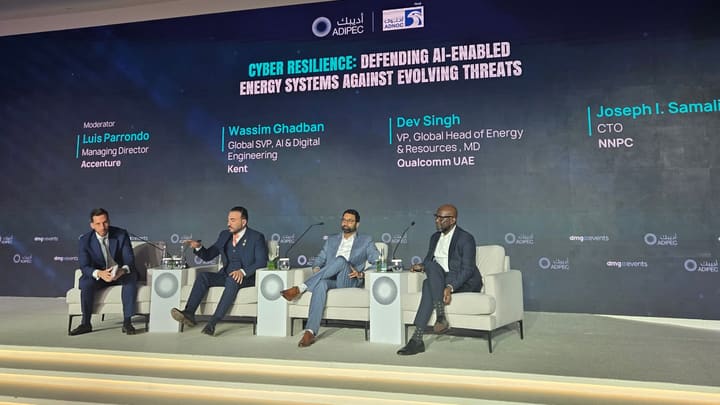
NNPC's chief technology officer told a panel on cyber resilience that NNPC had adopted a cyber security framework seen as durable and used it to support IT solutions. In OT, however, the framework cannot support implementation: “there is a gap that exists and that will have to be addressed”, from a sector-wide perspective. The same speaker said IT and OT teams are run separately, and some organisations are “still struggling” with where AI sits in the structure.
Luis Parrondo of Accenture, moderating that panel, supplied the scale of the problem. A leading energy company had told Parrondo that vulnerabilities reported by its automation vendor had “increased 20 times in one year”. Parrondo read this partly as testing maturing, and partly as AI being used to find weaknesses.
Wassim Ghadban of Kent placed security as a condition for remote and autonomous operation. Ghadban said Kent set up a dedicated cyber security unit that produced “safe, resilient, two-way communication to address remote operation”, and said that for autonomous operation “we need probably 10 steps in this OT cybersecurity”. Ghadban also described an AI assessment tool that tracks OT and IT data from design to operation.
Dev Singh of Qualcomm UAE addressed who owns the risk. Singh said traditional cyber security methods still apply but are not sufficient: “It has to be an end-to-end layering of cybersecurity”, with silicon providers responsible at device level and system integrators, service providers and operators each responsible for their own layer. Singh called this a shared responsibility.
Resilience: capacity, supply and systems
At the energy security roundtable, Hussein Shoukry of Siemens Energy said it is “very important to have a diverse energy mix”, and argued that no country can rely on only one or two sources. Shoukry later named physical exposure of infrastructure, localisation of equipment and skills, and regional cooperation as vulnerabilities, since a single country cannot localise and duplicate everything.
Tommy Kassem of Celeros Flow Technology said the company is seeing “a renaissance in nuclear”, and that the bottleneck in nuclear will not be production or materials: “It's actually going to be the human capital.” Kassem also noted that turbine, pump and wind manufacturers all depend on steel. Per Erik Holsten of ABB gave a similar answer on vulnerability, saying “the human factor of things is what prevents us from moving forward in a faster way”.
Storage was where the roundtable divided. A panellist said the breakthrough needed in storage had not been reached. Crane replied that customers would rely on solar storage for 24-hour power this year because “it is economically the best solution”. Anna Spektor of Linde, asked about gas, said there is no conflict between supporting natural gas today and investing in new sources.
A speaker at the grid session said that before building capacity, operators should get more from existing capacity through better visibility and coordination. That echoes the sequencing argument heard in the AI discussion.
According to highlights published by the organisers, Suhail Mohamed Al Mazrouei, the UAE's Minister of Energy and Infrastructure, said “we will need AI to design better and become more resilient”. Iva Petrova, Bulgaria's Minister of Energy, called energy security a shared regional effort. Those statements fit the roundtable speakers who stressed cooperation and human coordination.
What the floor recordings add
The floor recordings contained an admission that does not appear in the organisers' highlights. NNPC's chief technology officer said that a security framework cannot yet support OT implementation, and said IT and OT are run by separate teams, with some organisations still unsure where AI sits.
The recordings also supplied figures and a disagreement. They included Parrondo's 20-fold rise in vendor-reported vulnerabilities, KPMG's 46% task estimate and the Patterson-UTI trial results. The storage exchange between Crane and a panellist showed an actual difference of view.
The organisers' own figures were of a different kind. They reported 240,000+ attendees from 170 countries and more than 50,000 deals worth an estimated US$ 67 billion. These are the organisers' figures.
Sources
- ADIPEC 2026 floor recordings: six sessions and stand interviews. Inese Pritchard / The Stratawire (Reporter app). Interview; accessed 5 November 2026.
- ADIPEC 2026 organisers: day 1 highlights. ADIPEC 2026 (dmg events). Press release; accessed 6 November 2026.according to remarks published by the ADIPEC organisers.
- ADIPEC 2026 organisers: day 2 highlights. ADIPEC 2026 (dmg events). Press release; accessed 6 November 2026.according to remarks published by the ADIPEC organisers.
- ADIPEC 2026 organisers: day 3 highlights. ADIPEC 2026 (dmg events). Press release; accessed 6 November 2026.according to remarks published by the ADIPEC organisers.
- ADIPEC 2026 organisers: day 4 highlights. ADIPEC 2026 (dmg events). Press release; accessed 6 November 2026.according to remarks published by the ADIPEC organisers.
How this story was made
1 Ground truth
Reporter capture by Inese Pritchard: audio, photo, notes, captured . Capture item af928a85-3778-42f8-932b-6e066b5edf58.
Photo: Inese Pritchard / The Stratawire (documentary original, rights basis stratawire original).
2 Sources
5 sources listed above (Interview, Press release).
3 Models
- writer: claude:sonnet
- checker: zai:glm-5.3
4 Checks
- quotes word for word: pass (every quoted span found in the material)
- numbers in material: pass (every number found in the material)
- checker model: pass (minimax:MiniMax-M3: no problems listed)
- news value bar: waived (score 62; owner override)
5 News value
News value 62/100. The article reports concrete, named-source findings from an energy-industry conference, including NNPC's OT-security gap, KPMG's 46% estimate and Patterson-UTI trial results, but it is largely conference coverage rather than a major announcement or new deal. Judged by minimax:MiniMax-M3.
6 Published and updated
Published . No substantive update.
7 Links
Report an error or request a reply